Cellulase, Xylanase & Beta-Glucanase for Silage Inoculants
Enzymefarm supplies enzyme ingredients for silage inoculant and forage additive manufacturers building practical, defensible products for chopped forage systems.
For product managers and formulation teams, the question is not simply whether an enzyme belongs on the label. The question is which enzyme class supports the fermentation strategy, whether it stays compatible with the bacterial inoculant, how it behaves in the chosen carrier, and whether each batch can be produced with the same confidence at plant scale.
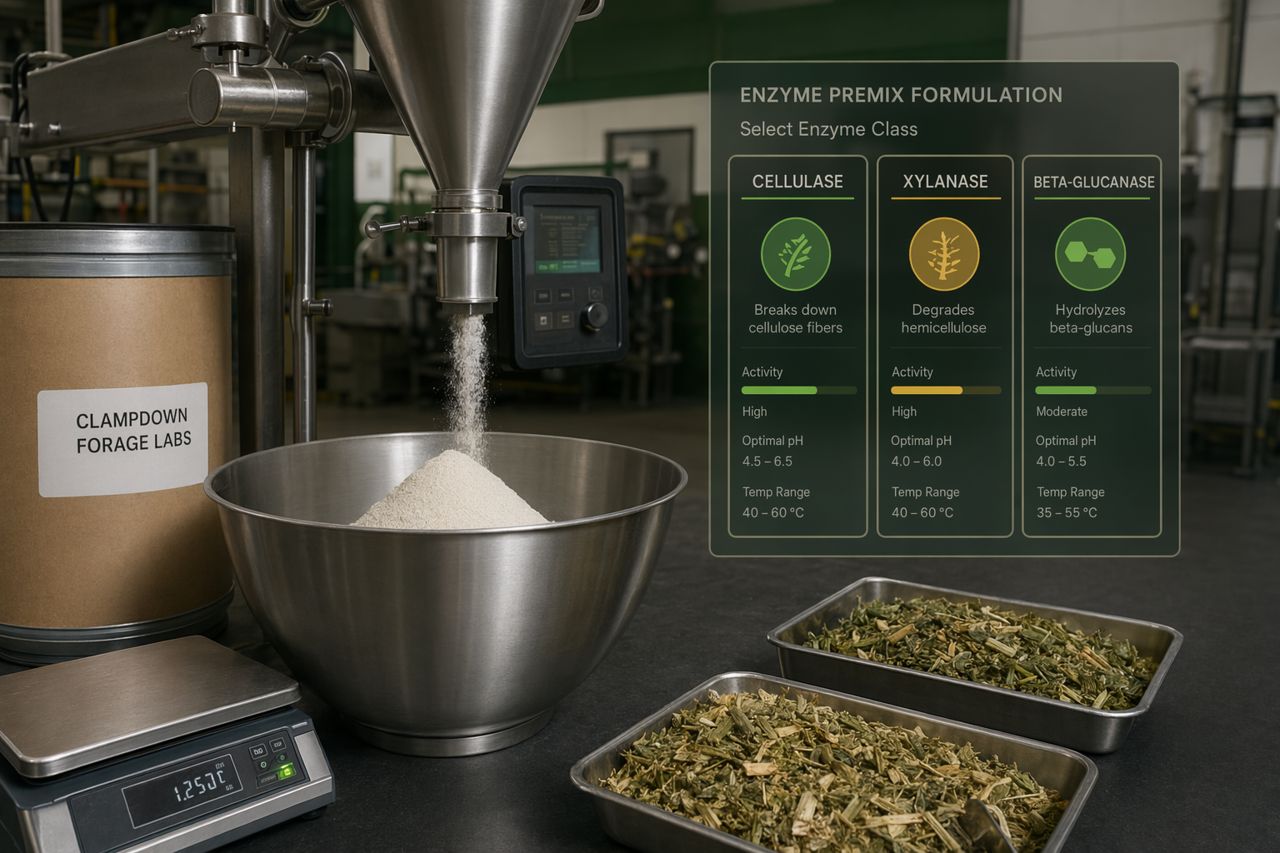
We support manufacturers evaluating cellulase, xylanase and beta-glucanase as complementary components in forage additive systems, including dry blends, water-soluble application formats, premix concentrates and private-label product lines.
For silage additive manufacturers, inoculant producers, private-label brands and distributors buying for resale. Business inquiries only; pack sizes, quantities and delivery terms are quoted per order. Request a quote with the product, quantity and destination.
Enzyme Selection for Silage Additive Formulators
Cellulase, xylanase and beta-glucanase are commonly considered when a silage additive needs additional fiber-release support alongside lactic acid bacteria. Each class acts on different structural carbohydrates within forage material, which makes selection dependent on crop profile, processing conditions, application format and the commercial claim you need to support.
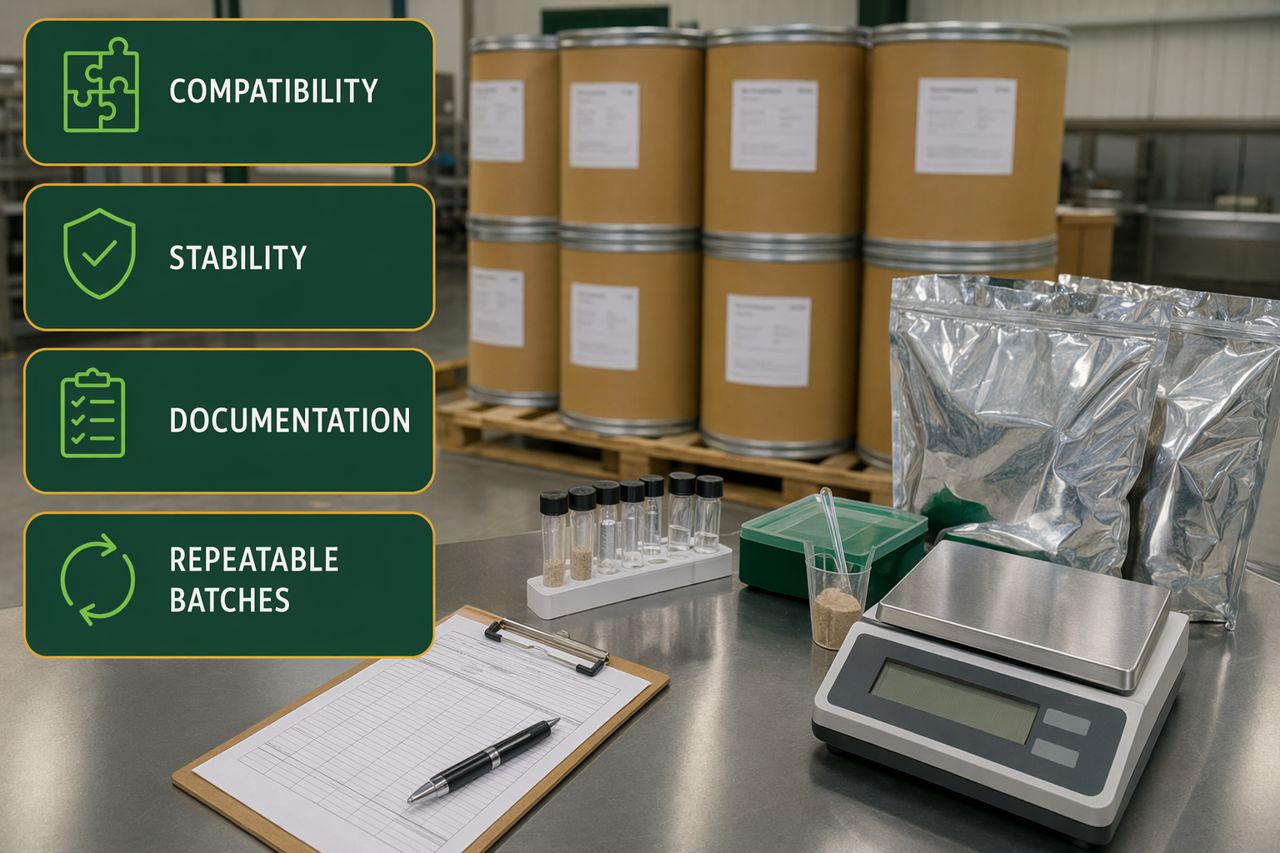
Enzymefarm helps you evaluate enzyme fit from a manufacturing and product-positioning perspective:
- Which enzyme class best matches your forage target
- Whether a single-enzyme or multi-enzyme system makes more sense
- How the enzyme fits with bacterial inoculants and carrier materials
- Inclusion-rate planning for commercial formulations
- Stability expectations for storage, transport and plant handling
- Documentation required by purchasing, QA and technical sales teams
- Repeatable batch supply for ongoing production schedules
We keep the discussion formulation-led. No inflated claims, no farm-romance language, and no unnecessary complexity when a cleaner product architecture will perform better commercially.
Where Each Enzyme Class Earns Its Place
Cellulase for Structural Fiber Access
Cellulase is typically evaluated when a formulation needs support in opening cellulose-rich plant material and improving access to fermentable substrate. In silage additive systems, it is often considered as a complement to homofermentative or mixed bacterial inoculant strategies where early fermentation momentum matters.
For manufacturers, the value is not just biochemical activity. It is whether cellulase can be incorporated cleanly into the product format, remain stable through normal storage expectations, and support the field outcome your sales team is expected to defend.
Cellulase may be considered for formulations targeting:
- Grass, maize, lucerne or mixed-forage programs
- Fiber-release positioning
- Faster fermentation support
- Dry matter preservation narratives
- Premium inoculant lines requiring enzyme differentiation
Xylanase for Hemicellulose-Rich Forage Structures
Xylanase is often selected for its role in targeting xylan-containing hemicellulose fractions. In forage additive manufacturing, it can help broaden the formulation beyond a cellulose-only approach and may be useful where crop type, maturity and chop profile create a more complex fiber matrix.
For product managers, xylanase can be a practical route to stronger differentiation without overloading the formulation. It may also support a more balanced enzyme package when paired with cellulase or bacterial inoculant strains selected for rapid lactic acid production.
Xylanase is commonly evaluated when the product brief calls for:
- Broader plant cell wall access
- Support across variable forage inputs
- Multi-enzyme positioning
- Improved substrate availability for fermentation
- A stronger technical story for distributor training
Beta-Glucanase for Targeted Glucan Breakdown
Beta-glucanase can be considered where beta-glucan-containing structures are relevant to the target forage or where the manufacturer wants a more complete fiber-release package. Its value is often strongest when used as part of a defined enzyme blend rather than as a generic label addition.
For formulation teams, beta-glucanase selection should be tied to the crop profile, intended claim structure and compatibility with the broader additive system. We help assess whether it adds meaningful value or whether the formulation is better served by a simpler cellulase-xylanase approach.
Beta-glucanase may support formulations focused on:
- Complementary fiber-release action
- Specialist forage additive lines
- Multi-enzyme inoculant systems
- Differentiated technical positioning
- Product upgrades without changing the bacterial backbone
Two-part silage kits: how the bacteria and the enzyme blend split the work
Freshly chopped forage carries only a small population of lactic acid bacteria next to a large load of spoilage bacteria, moulds and yeasts, and most of those competitors need air. Air left in the clamp in the first days of fermentation lets them heat the silage, and in the worst case the forage moulds and rots. The bacterial part of an additive is there to make lactic acid bacteria the dominant group and hold the other microbes back. The enzyme part solves a second problem: in the plant cell wall, hemicellulose and lignin form a dense network around the cellulose, which keeps sugar locked away from the bacteria and lowers the digestibility of the feed. For a formulator, that is the commercial case for a combined product: one application that both steers fermentation and opens the fibre.
What the enzyme blend contributes
- In whole-plant corn, the hemicellulose is mainly xylan. Xylanase cuts the xylan backbone into xylo-oligosaccharides and xylose, breaks open the lignin and hemicellulose network, and frees the cellulose and cell contents inside.
- Cellulase is an enzyme system, not one enzyme: endo-cellulase, exo-cellulase and beta-glucosidase work together and take cellulose all the way to glucose, which the lactic acid bacteria use as a carbon source to grow faster.
- Once xylanase has opened the structure, cellulase can keep releasing glucose during storage, and the opened fibre raises dry matter and fibre digestibility in the rumen.
- The enzyme part of a well-built kit is mainly cellulase and xylanase, screened and blended specifically for the conditions at the silage clamp and for ruminant digestion.
What the bacterial part contributes
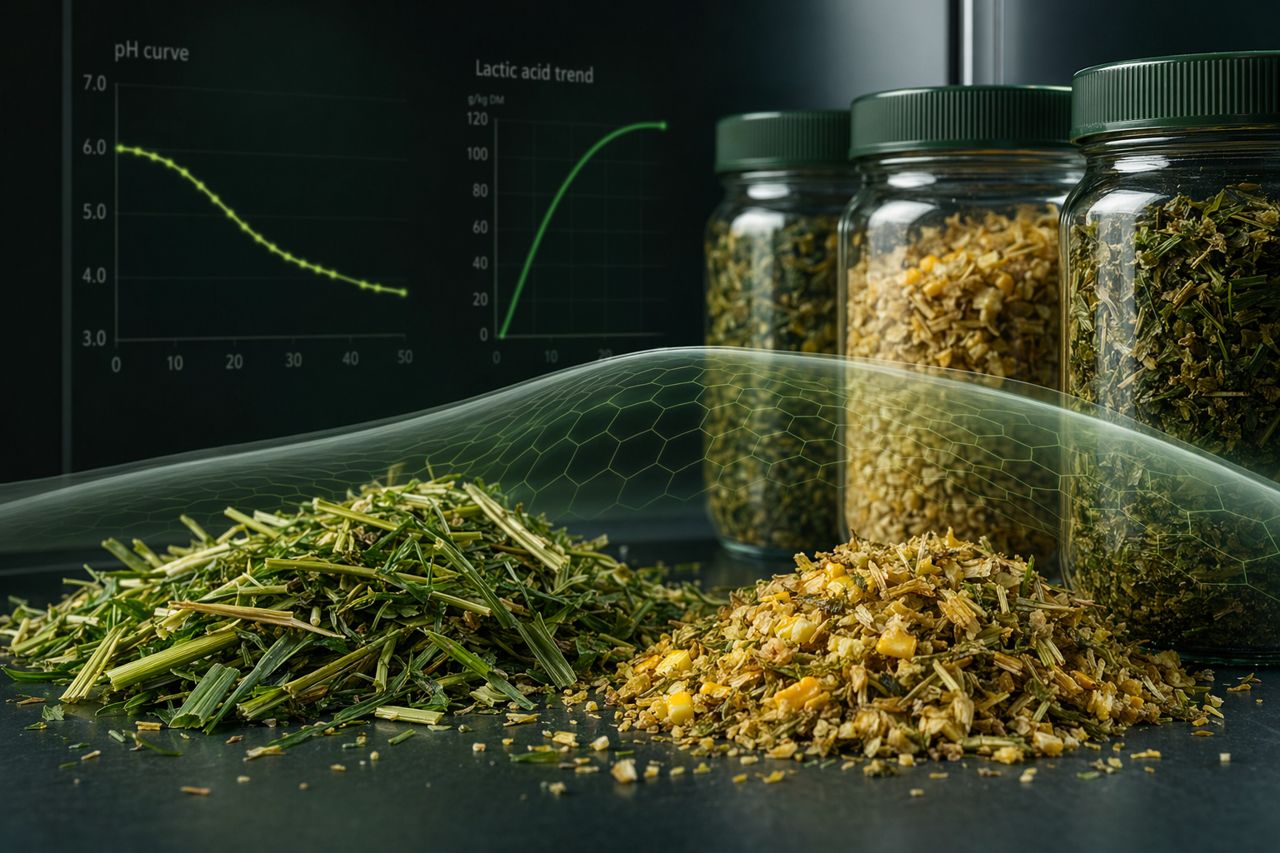
- Homofermentative strains such as Enterococcus faecalis turn glucose and other water-soluble carbohydrates into lactic acid, so pH falls quickly and moulds, spoilage bacteria and butyric clostridia are held back in the first 0 to 3 days.
- That early pH drop avoids butyric fermentation and reduces dry matter loss and mycotoxin formation during storage.
- Heterofermentative strains, Lactobacillus plantarum and Lactobacillus buchneri, produce lactic acid and acetic acid; when the clamp is opened, the acetic acid holds back moulds and yeasts, which improves aerobic stability and reduces losses at feed-out.
- Combining homofermentative and heterofermentative strains in one culture covers both stages: fast acidification in the clamp and stability after opening.
- Fermentation ends when enough lactic acid has built up, at a pH of about 4.0, to stop microbial activity and keep the nutrients in the forage.
How the kit is applied on the farm
The two parts are packed separately and combined on site: 1 g of bacterial culture and 15 g of enzyme blend are dissolved in 2 L of water, shaken, and sprayed evenly over 1 tonne of fresh forage. Treat that ratio as one reference design, not a dose recommendation: your own enzyme strength, carrier and target forage set the inclusion you put on the label.
Questions to settle before a pilot batch
| Decision | Why it matters for a two-part kit |
|---|---|
| Which enzymes sit in the blend | Xylanase opens the xylan network; cellulase turns cellulose into glucose for the bacteria |
| Which strains the enzyme must support | Homofermentative strains drive the early pH drop; heterofermentative strains protect the face after opening |
| Packed together or separately | The reference kit keeps culture and enzyme apart until they are mixed in water on site |
| Target crop | Whole-plant corn hemicellulose is mainly xylan, so corn lines lean on xylanase |
| Strength and pack size | Set per order: send the product, the quantity and the destination with your request |
Request a quote for the enzyme side of a two-part kit, or for a ready blend to pair with your own culture.
Built Around Bacterial Inoculant Compatibility
Most silage enzyme projects are not standalone enzyme products. They are part of a bacterial inoculant or forage additive system. That means compatibility matters from the first formulation discussion.
Enzymefarm supports practical review of:
- Interaction with lactic acid bacteria platforms
- Carrier compatibility in dry or soluble formats
- Moisture sensitivity and handling controls
- Blend uniformity in premix and finished product stages
- Packaging expectations for storage and shipment
- Application-format requirements for contractors and end users
- Label-positioning discipline across regions and customer segments
The aim is to avoid a formulation that looks strong on paper but creates production friction, inconsistent blending, questionable shelf presentation or difficult technical support questions later.
Manufacturing Reliability Comes First
Silage additive manufacturers need enzyme ingredients that behave consistently through procurement, intake, blending, packing and dispatch. A formulation only works commercially if the production team can repeat it.
Our supply approach supports:
- Defined ingredient specifications for purchasing and QA review
- Batch-to-batch consistency expectations
- Documentation packages for internal approval workflows
- Practical handling guidance for production teams
- Compatibility review for existing carrier systems
- Support for pilot batches and scale-up planning
- Commercial supply alignment for seasonal production windows
We understand that forage additive production is often calendar-sensitive. A delayed ingredient, unclear documentation package or unstable blend can disrupt an entire seasonal run. Our role is to make enzyme sourcing cleaner, more predictable and easier to defend internally.
Field-Validated Outcomes Without Overclaiming
Enzymes in silage additive systems should support outcomes your commercial team can explain and your technical team can stand behind. Typical performance goals may include:
- Support for faster acidification
- Improved access to fermentable substrate
- Cleaner fermentation profile positioning
- Better preservation narrative for treated forage
- Differentiation in premium inoculant programs
- More complete technical support for distributor channels
We help manufacturers connect enzyme selection to field-validated fermentation outcomes without building claims that exceed the formulation, the crop context or the available evidence.
Formulation Questions We Can Help Answer
Bring us into the project when your team is deciding:
- Should this inoculant include cellulase, xylanase, beta-glucanase or a blend?
- Which enzyme class best fits maize, grass, lucerne or mixed forage targets?
- Will the enzyme work in the current carrier system?
- Can the ingredient be handled reliably in our plant?
- What documentation will purchasing and QA need?
- How should we approach inclusion-rate planning for pilot production?
- Is this enzyme package aligned with the product’s commercial promise?
- Can we support a private-label or distributor-specific formulation?
The earlier these questions are addressed, the easier it is to prevent reformulation, relabeling and production delays.
Supply for Product Managers, Technical Teams and Additive Plants
Enzymefarm works with B2B manufacturers that need enzyme ingredients for:
- Silage inoculants
- Forage additive premixes
- Water-soluble application products
- Dry blend additive systems
- Private-label silage treatment products
- Premium fermentation-support lines
- Regional crop-specific formulations
We are built for formulation teams that want clear technical discussion, commercially direct supply conversations and repeatable ingredient performance.
Request a Quote
If you are evaluating cellulase, xylanase or beta-glucanase for a silage inoculant or forage additive, use the on-site request a quote form and include as much formulation context as you can.
Start with the product, the quantity (per order and per season) and the destination country. Other helpful details include:
- Target forage or crop group
- Current product format
- Bacterial inoculant platform, if already selected
- Carrier system or premix structure
- Desired label positioning
- Production scale or seasonal demand estimate
- Packaging and documentation requirements
- Any stability or compatibility concerns
Pack sizes, quantities and delivery terms are quoted per order.
Ready to compare enzyme options for your next silage additive formulation?