Dairy nutrition claims for silage additives: keep the promise tied to the formulation
For a silage additive manufacturer, dairy nutrition claims can create commercial pull — but only when they are built on formulation logic, controlled documentation, and repeatable field performance. The strongest claim set does not start with broad animal-performance language. It starts with what the product is designed to do in chopped forage: support fermentation direction, improve substrate access, stabilize the ensiling environment, and help deliver more consistent feed-out quality.
Enzymefarm works as a silage enzyme supplier for forage additive manufacturing where claims, inclusion rate, compatibility, and batch reliability must line up before a product reaches a distributor, nutritionist, or dairy account.
This article outlines how product managers can frame dairy nutrition claims without overreaching the evidence behind the additive.
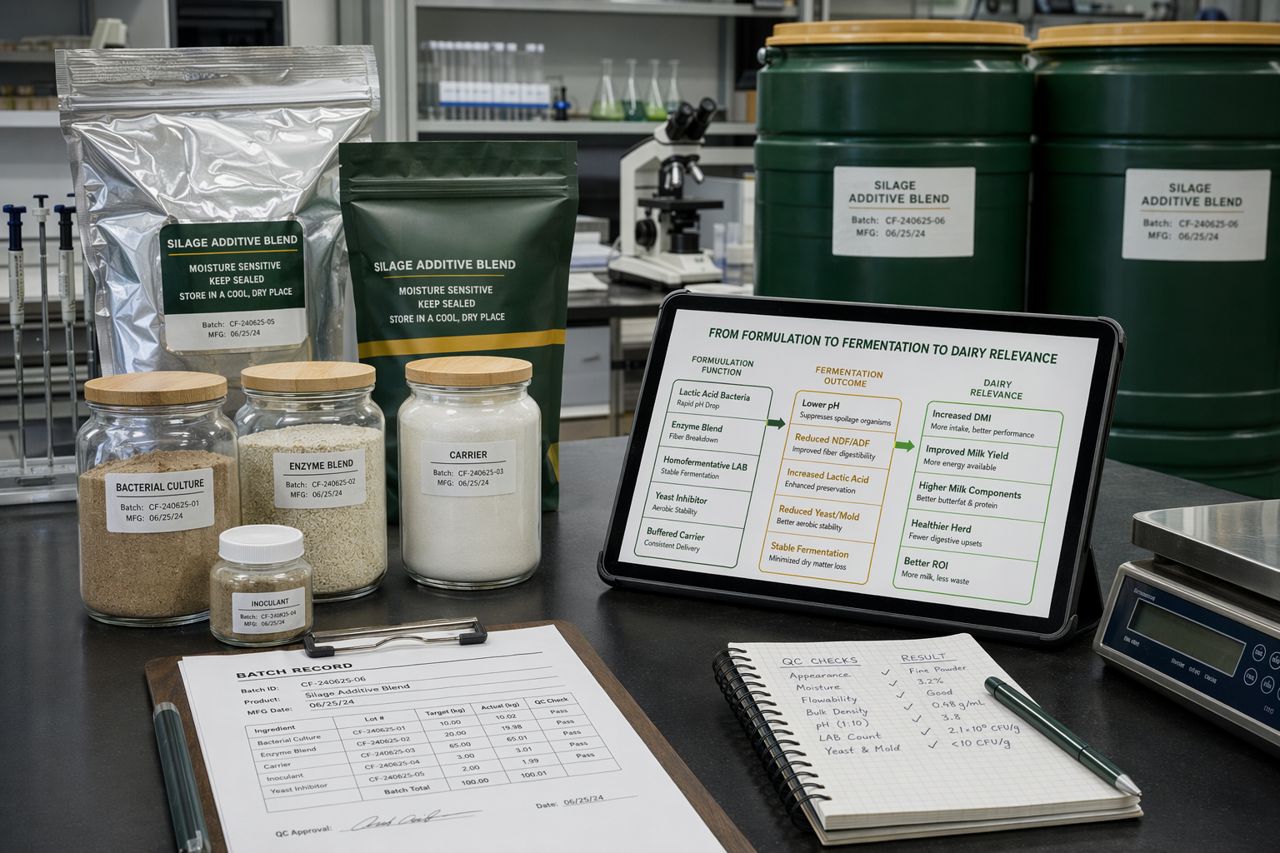
The claim ladder: from formulation function to dairy relevance
A practical claim structure moves in layers. Each layer should be supported by the right type of evidence.
1. Formulation function
This is the most direct claim layer. It describes what the enzyme component is intended to support inside the silage additive system.
Examples of defensible formulation-function language include:
- Supports access to plant cell wall carbohydrates during ensiling
- Complements lactic acid bacteria in forage fermentation programs
- Helps improve substrate availability for fermentation pathways
- Designed for use in dry or liquid silage additive formats
- Selected for compatibility with common forage inoculant blends
This layer is where enzyme selection matters most. A xylanase-forward system, cellulase-supporting system, or blended carbohydrase approach should be matched to the forage target, product format, and application rate expectations.
2. Fermentation outcome
The next claim layer connects formulation function to measurable silage outcomes. This is still additive-centered, not animal-performance-centered.
Examples include:
- Supports faster fermentation direction under validated use conditions
- Helps reduce variability in fermentation profiles across forage types
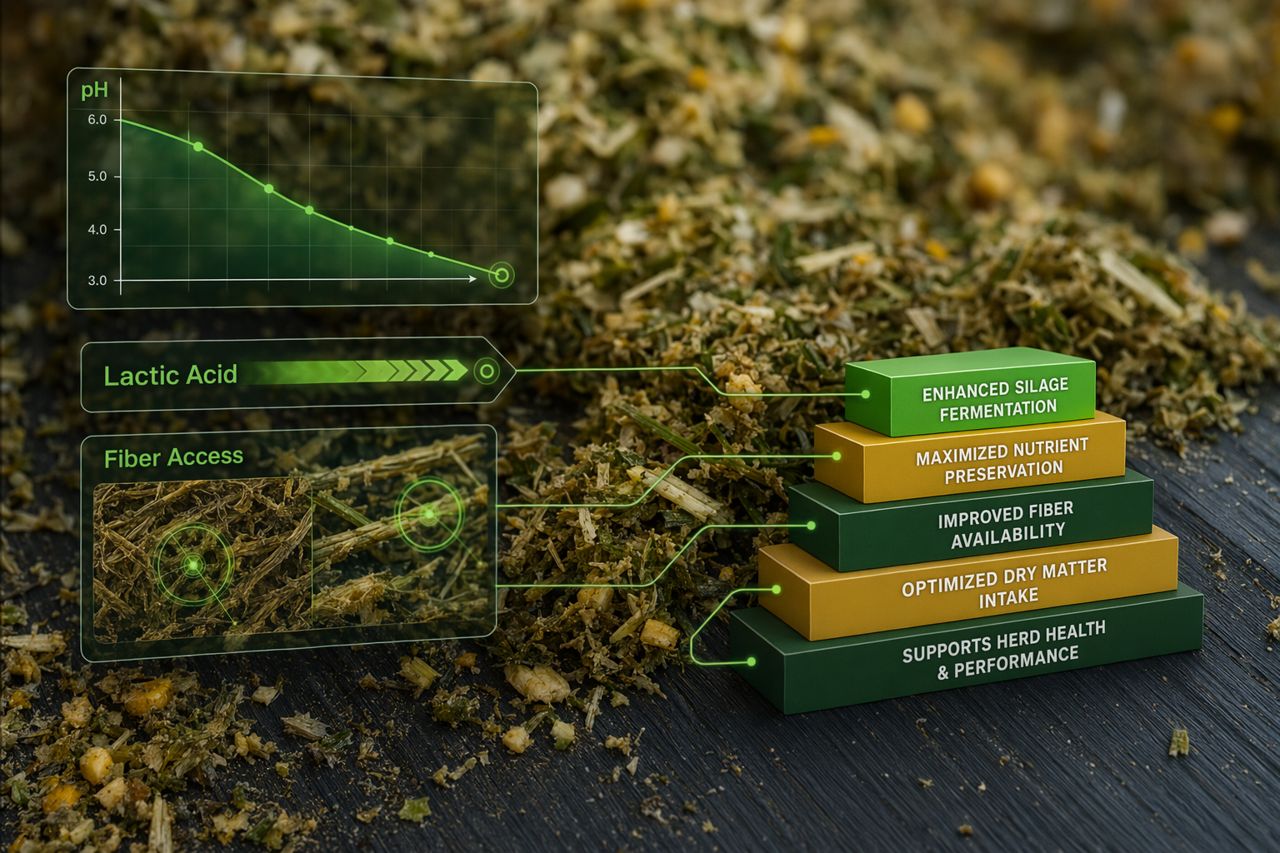
- Supports pH decline when paired with compatible inoculant organisms
- Helps improve consistency of preserved forage quality at feed-out
- Designed to support lactic-acid-driven preservation programs
These claims require controlled internal data, field trial summaries, or customer validation records. They should also define the forage conditions where the claim applies: corn silage, grass silage, high-moisture forage, mixed forage, or region-specific substrates.
3. Dairy nutrition relevance
This is where manufacturers need discipline. Dairy relevance should usually be framed as a feed-quality support claim rather than a guaranteed milk-production claim.
Stronger language:
- Supports the production of consistent silage for dairy ration programs
- Helps preserve fermentable substrate value in ensiled forage
- Designed to support feed-out consistency for nutrition-managed dairies
- Helps additive manufacturers position silage quality within dairy feeding systems
Riskier language:
- Increases milk yield
- Improves feed conversion
- Raises butterfat
- Replaces ration reformulation
Unless the additive has specific, repeatable animal trial evidence under defined conditions, avoid turning a forage preservation outcome into a direct animal productivity guarantee.
What product managers should document before approving claim language
A claim is only as strong as the file behind it. Before launching or refreshing a dairy-facing silage additive, build a claims package that your commercial, QA, and regulatory teams can all use.
Recommended documentation set
- Enzyme specification sheet aligned to the final additive format
- Inclusion-rate rationale for the target application method
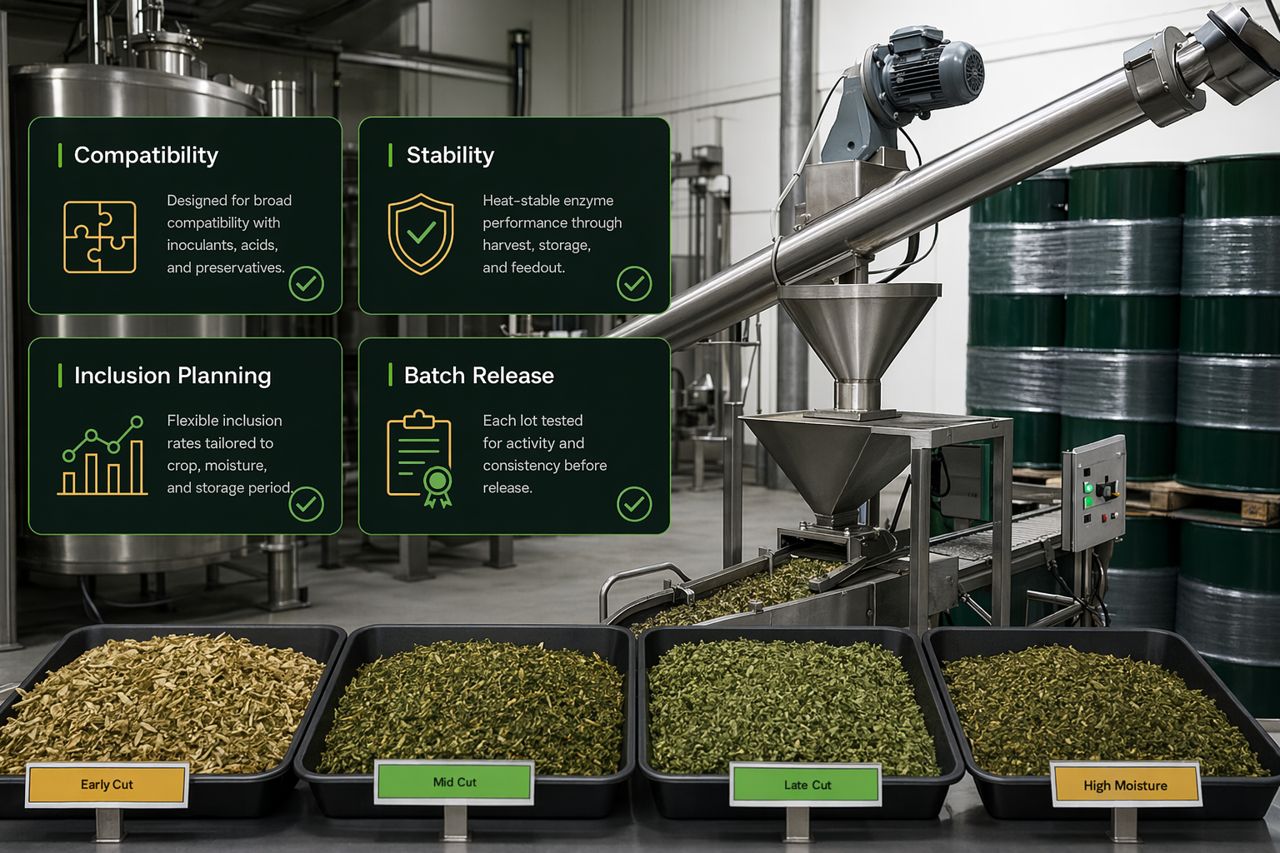
- Compatibility notes with inoculant strains, carriers, minerals, acids, and preservatives
- Stability data for the intended dry blend, water-soluble powder, or liquid concentrate
- Manufacturing handling guidance for blending order, moisture exposure, and storage
- Batch-to-batch release documentation
- Trial summaries showing fermentation or preservation outcomes
- Label and technical sheet language mapped to supporting evidence
The goal is not more paperwork for its own sake. The goal is to prevent a claim from outrunning the formula.
Enzyme selection should follow the forage and the additive format
Dairy nutrition positioning often fails when the enzyme system is chosen too generically. A formulation designed for broad forage use may need a different enzyme balance than one designed specifically for corn silage, grass silage, alfalfa, or high-moisture forage.
Key formulation questions
- Which forage substrates are most important to the commercial line?
- Is the product positioned for front-end fermentation speed, fiber access, aerobic stability support, or consistency?
- Will the enzyme be used with homofermentative, heterofermentative, or combined inoculant systems?
- Is the finished product a dry blend, soluble powder, premix, or liquid concentrate?
- What temperature, humidity, and distribution conditions will the additive experience?
- What application rate range is commercially realistic for the customer base?
For manufacturers, these questions are not academic. They affect cost-in-use, label claims, shelf life, distributor confidence, and repeat orders.
Compatibility can make or break the commercial claim
A silage enzyme may look suitable on paper and still underperform inside a real manufacturing system if compatibility is not controlled.
Watchpoints in silage additive manufacturing
- Carrier moisture and flow behavior
- Contact time with acidic components
- Mineral interactions in premix systems
- Preservative exposure in liquid products
- Blend uniformity at low inclusion rates
- Storage stability after packaging
- Solubility and tank-mix behavior for applicator use
- Inoculant viability when enzymes and microbes share the same format
For dairy-facing claims, compatibility is not a back-office concern. If the additive does not remain stable through storage and application, the nutrition-positioned claim becomes difficult to defend.
How to write stronger dairy claim language
Below are practical claim rewrites that keep commercial value while reducing overreach.
Overstated
"Improves dairy cow performance through superior silage digestibility."
Stronger
"Formulated to support forage fermentation and feed-out consistency in dairy silage programs."
Overstated
"Unlocks more milk from every ton of forage."
Stronger
"Supports access to fermentable plant substrates during ensiling, helping manufacturers position more consistent dairy forage additives."
Overstated
"Guaranteed to increase nutrient availability."
Stronger
"Designed to support enzyme-assisted fiber access and fermentation direction under defined use conditions."
Overstated
"Works in all silage conditions."
Stronger
"Selected for specified forage types, additive formats, and storage conditions documented in the formulation file."
Build claims into the product development process
The best time to control dairy nutrition claims is not after the label is drafted. It is during enzyme selection and pilot blending.
A formulation-led process should connect:
- Target forage profile
- Enzyme function and compatibility
- Inclusion-rate strategy
- Finished-product format
- Stability and packaging conditions
- Fermentation validation plan
- Claim language and sales documentation
When those elements are connected, the finished additive is easier to sell, easier to defend, and easier to repeat at scale.
Where Enzymefarm fits
Enzymefarm supplies enzyme systems for silage additive manufacturers that need formulation-ready inputs, practical documentation, and commercially usable technical support.
We help product managers evaluate:
- Enzyme fit for forage targets and additive formats
- Compatibility with inoculant and carrier systems
- Inclusion-rate planning for cost-in-use and label positioning
- Stability expectations for storage and distribution
- Documentation packages for product sheets and internal approvals
- Scale-up considerations for repeatable batch performance
The result is a cleaner path from enzyme selection to a finished dairy-positioned silage additive.
Practical takeaway
Dairy nutrition claims should be built from the silage additive outward — not from the milk tank backward. Start with the formulation function, validate the fermentation outcome, then connect the result to dairy ration relevance in disciplined language.
If you are developing, reformulating, or line-extending a silage additive for dairy markets, Enzymefarm can help you specify the enzyme system behind the claim.
Request a quote for a formulation-ready silage enzyme recommendation and supply discussion.